
Elderberry Syrup Recipe

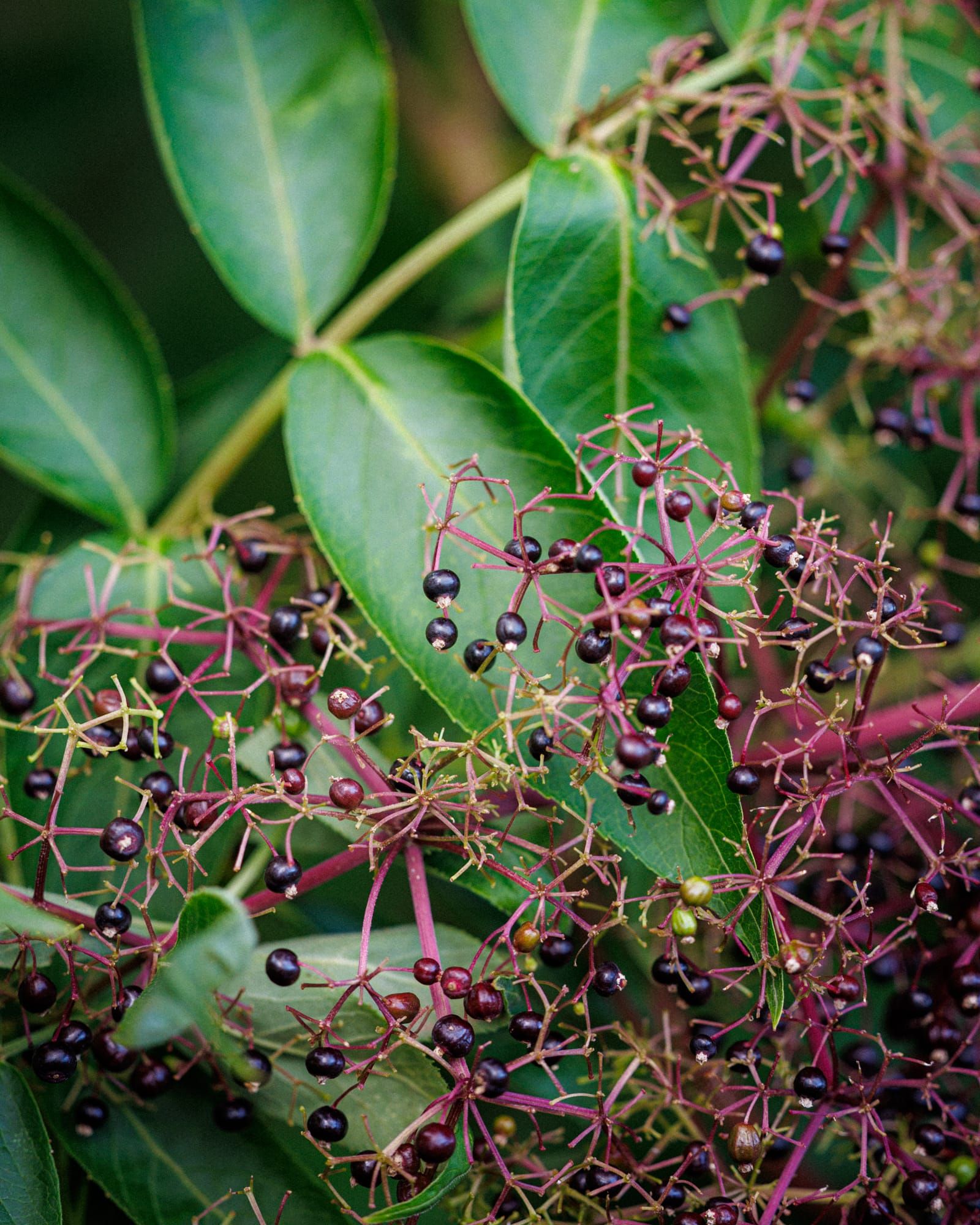
Begin with Elderberries
A nice starting point for a good size batch that will last you and your family a few months:
- 2 cups dried elderberries (200 g) per quart of cold water
- or 100 g / pint
You can scale up or down depending on how much you want to make at one time. If starting with fresh elderberries, double the amount of elderberries used by weight to account for water content (4 cups or 400 g / quart of cold water).
Process
Bring to a low boil - note the level of the liquid in the pot at the beginning, you are eventually going to reduce this level by half.
Once at a low boil, turn down heat to a simmer, leave the lid off, and reduce to half.
Once reduced to half, cut the heat, and add your additional aromatic herbs and cover pot with lid to retain volatile oils while steeping. Below are some of my favorite aromatic herbs to add to Elderberry Syrup. The quantities below are based on a quart-sized batch:
- 20 g elderflower
- 20 g dried orange peel (or see below)
- You can also add the entirety of one lemon and / or orange. You can either juice first and then chop up the rind and toss in the pot, or just chop up the whole citrus, peel and all, and toss in the pot with the rest of the aromatic herbs. I tend to do the second because I know I will be pressing the whole lot of herbs at the end when straining, but if you don't have an herb press you might consider juicing separately to get as much juice as possible.
- 20 g Spicebush (Lindera benzoin) berries or twig or Spikenard / Wild Sarsaparilla (Aralia spp.) berries
- 30 g fresh ginger (or 10 g dried)
- 15 g Cinnamon bark
- 3 Cloves
Once aromatics are added, cover pot, remove from heat, and steep until cool (or ~100 degrees, leaving it a little warm will help to incorporate the honey after straining).
Strain and press liquid.
Sweetening
Ratio of Honey to Liquid: Add honey for a 'honey : liquid ratio' of 1:2 - 1:1.5.
So if you started with a quart and you end up with a pint of liquid (16 oz), you would add 8-12 oz of honey (or cane sugar, maple sugar, maple syrup, or any kind of sweetener) to the liquid depending on how sweet you want it.
Essentially, you are combining:
- 2 parts reduced decoction (2 cups or 16 oz)
- 1 - 1.5 parts honey (1-1.5 cups or 8-12 oz of honey or other sweetener)
Once you've sweetened the reduced decoction, you have yourself some Elderberry Syrup!
Bottle and store in the fridge for around 1-2 months (sugar only extends the shelf life of a tea / infusion / decoction for a few weeks to a few months depending on how much sugar is present). Don't worry, you will likely use it all up before then, but keep an eye out for any developing mold, and if you see any just play it safe and toss it.
In the meantime, take 1 tsp - 1 tbsp 1-3 x a day for a few days whenever you're feeling like your immune system is feeling a little compromised, or if you just want to keep your immune system on guard throughout the colder months.
If you want to extend the shelf life and add a nice zip to your elderberry syrup, you might consider...
Plussing it up as an 'Elderberry Oxymel'
Making your elderberry syrup into an elderberry oxymel takes the syrup one step further with vinegar. Either Apple Cider Vinegar on its own, or vinegar infused with additional herbs (you might consider infusing apple cider vinegar with fresh nettle leaf as vinegars can extract minerals very well). This is pretty much always how my elderberry syrup ends up because I love the extra zing of the vinegar!
In this case, the ratio would be:
- 2 parts reduced decoction
- 1 - 1.5 parts honey (or other sweetener)
- 1 part Apple Cider Vinegar (infused or not)
Shelf life for the oxymel is up to 3-4 months, especially if stored in the fridge. But as I mentioned above it's a good idea to keep an eye out for any developing mold. With the raw honey and raw vinegar you added, this potion is very much ALIVE and therefore still conducive to feeding and generating more life (such as mold). If you see any, toss it. Again, with how tasty your potion has become it is not likely the mold will beat you to it.
Enjoy!
No spam, no sharing to third party. Only you and me.
Member discussion