
Bioregionalism

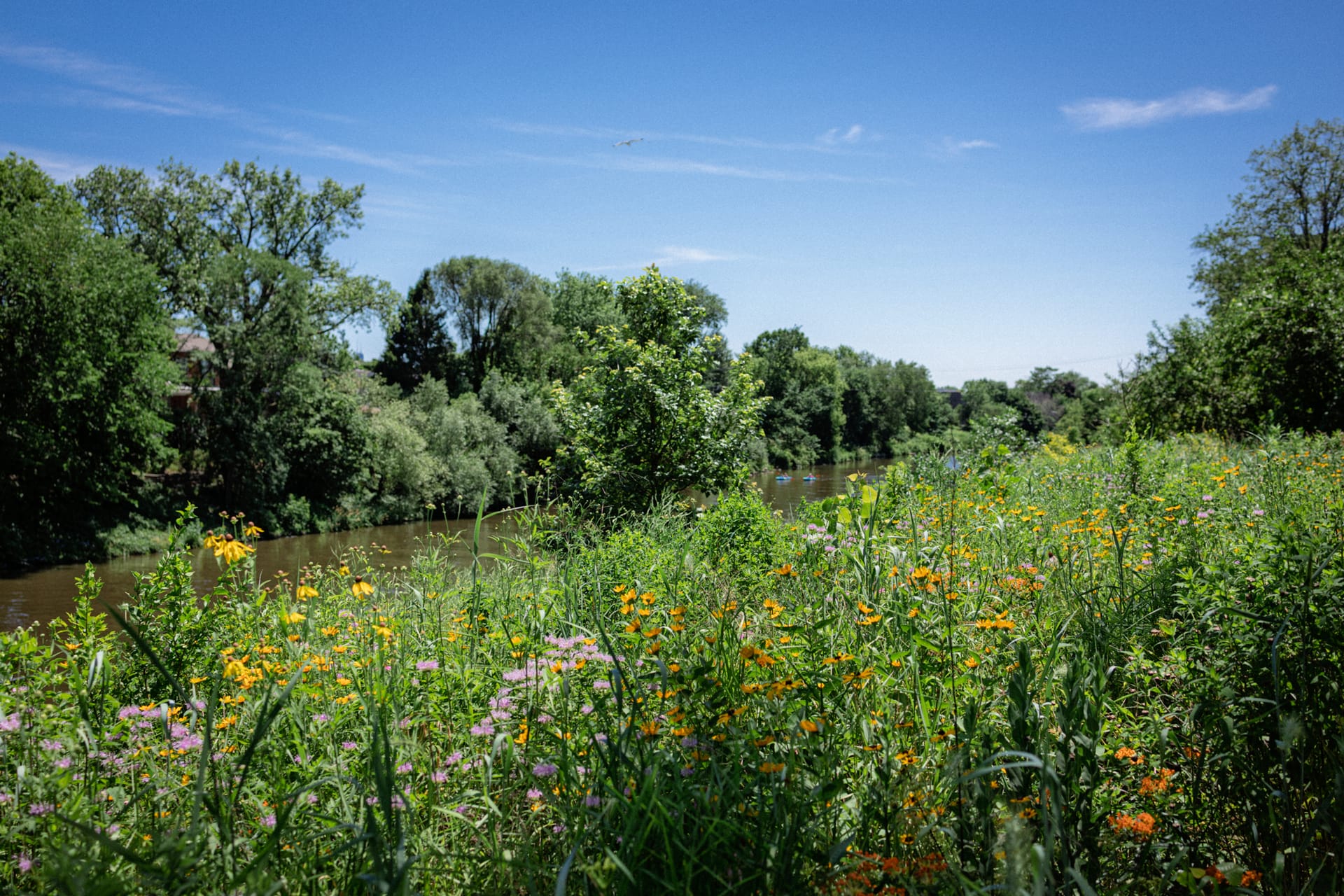
A subtle, yet significant shift in thinking about our homeplace
Where is home for you?
What informs your sense of connection to place?
Culture and history play a significant role here, but only in a limited sense. More often than not, the particular flavor of culture and history that influence our sense of place lacks a very necessary kind of earthiness – specifically, the influence of the physical landscape that provides the very foundation for our unique 'homeplace' to hold space for native habitats and for humans to grow gardens, vibrant neighborhoods, arts districts, and skyscrapers.
When our definition of home lacks this 'earthy' influence of the physical landscape, it makes it really difficult to feel a sense of rootedness in the land we live, love, and work upon on a daily basis.
I want to preface the rest of this discussion by saying that our exploration of bioregionalism will be rooted in the Chicago Region, because that's where I am and that's where I call my home-place. If you're reading this from outside of the Chicago region, these principles absolutely apply to your home-place, but the landmarks and physical characteristics will likely be quite different. Such is the contextual beauty of the bioregional approach!
If you're in Chicago like I am, if you love Chicago like I do, we owe a significant debt of gratitude to the land (and people who stewarded this land pre-colonization) for the mere existence of Chicago as an urban center (a big shoutout to the Chicago Portage which formed as a result of the retreat of the Wisconsin glaciation northward).
And if you're a Chicagoan who didn't know about the Chicago portage before now, no judgement to you in the slightest, as this earthier flavor of awareness isn't widely taught, but it is the first step towards developing a bioregional awareness, which I assure you, will help you fall deeply in love with wherever you call home.
An Opening Notion of Bioregionalism
What am I speaking of when I refer to a 'bioregional awareness'? We'll start simple and then introduce a little more nuance as we go.
Bioregionalism is about getting to know the place you live, beyond the surface level stuff of recent history. Bioregionalism offers a model for how we might begin to think about and engage with home, specifically, the particular home we find ourselves in every moment of every day.
Names and Language are Important Here
What we call our home depends on the scope and orientation. But we have to remember that language both facilitates communication and shapes reality. Some folks do not like to use the name 'Chicago' because it is the colonized name of the city. Zhigaagoong is a name for this land derived from the Native Anishinaabemowin language, which I would consider more accurate from a bioregional perspective.
But our goal here is not to show off our bioregional prowess, our goal is to learn more about where we live so we can embody a deeper sense of relationship, but also so we can inspire others to do the same (see more in the 'Principles' section below).
While it is true that the name 'Chicago' does not accurately name a place that has been lived upon and stewarded for several millenia prior to the settlement and incorporation of the city in 1833, we have to start with common ground before sprinkling in the nuance. So I freely use the name Chicago with than in mind and introduce the nuance when folks are ready for it. And since you're here reading this now, you clearly are!
What becomes interesting about adopting a bioregional perspective is that the name we conjure for any given place is highly dynamic, and highly dependent upon the current configuration of our relationship at any given moment based upon where we are at, who we are speaking to, and the context within which we are speaking (for example, if I am speaking about the hydrological aspects of a particular plant community, I am more likely to name a place according to watershed, and if I am speaking about the history of indigenous stewardship practices, I might be more likely conjure the name Zhigaagoong).
Turn and Face the Strange
Bioregionalism asks us to notice first and foremost our geographical area as defined by ecological systems rather than political and social boundaries. As such, we are inspired to ask questions that orient our awareness towards the other-than-human world, which, at first noticing may appear quite unknown or strange to us.
What happens to us when we begin to see ourselves as citizens of a physical place delineated by ecology rather than arbitrary political divisions? How does it inform our sense of who we are as humans?
Bioregionalism, whose tenets were articulated by the environmentalist Peter Berg in the 1970s, and which is widely visible in indigenous land practices, has to do with an awareness not only of the many life-forms of each place, but how they are interrelated, including with humans. Bioregionalist thought encompasses practices like habitat restoration and permaculture farming, but has a cultural element as well, since it asks us to identify as citizens of the bioregion as much as (if not more than) the state. Our 'citizenship' in a bioregion means not only familiarity with the local ecology but a commitment to stewarding it together. - Jenny Odell, How to do Nothing
This turning of attention allows us to expand our sense of home, and thus expand our sense of responsibility and custodial efforts toward the land.
Rooting our Explorations – The Chicago Region
The Chicago Region is a 22-24 county region at the base of Lake Michigan with some 2800 vascular plant species. This rich diversity is primarily because we occupy a transition zone between large-scale ecosystems, standing at the precipice and convergence of two major biomes (Temperate Grasslands and Temperate Broadleaf & Mixed Forests) with three distinct bioregions, known generally as the Northern Great Lakes Forests Bioregion from the Northwest, Tallgrass Prairie to the West, and Temperate Eastern Deciduous Forest (although there are more specific names for these bioregions which we'll discuss below). The term ‘ecotone’ is often used to name the transitional interface between two or more biomes or ecosystems.
From a bottom-up perspective, we might view the Chicago Region as woven together by various watersheds which inform and intersect several natural divisions, which are nested within a larger ecoregion, which is nested within a larger bioregion.
Watersheds, Natural Divisions, Ecoregions, & Bioregions
If you want to deeply orient yourself, start with the details closest at hand. So many homeplaces have oriented themselves around the availability of water, and this is why knowing your watershed is foundational to zooming out to the bioegional level.
Watersheds
Generally the watersheds are named after the bodies of water to which the area's water drains, but historically would also be the source of water for communities and agriculture.
Chicago has a few watersheds that may be defined differently depending on the organization that defines them. Some are more broad (e.g., the 'Chicago / Calumet Watershed'), some more specific (e.g., 'Cal-Sag Channel Watershed') – Simply developing an awareness of the nearby bodies of water is more important than knowing the official name of the watershed, but here are a few starting points depending on what neighborhood you live in:
The Chicago/Calumet watershed in northeastern Illinois and northwestern Indiana is part of the Illinois River basin which flows into the Mississippi. We're surrounded by the Des Plaines, Lake Michigan, and Kankakee watersheds.
The Chicago River system is comprised of a network of rivers and constructed waterways. The Chicago River, Calumet River, and their main tributaries once flowed into Lake Michigan, but a series of canals and channels were built in the late 19th and early 20th centuries to divert this flow into the Des Plaines River.
The primary reason for the reversal was to stop the flow of sewage, which was dumped into the river, from mixing with the city's drinking water supply in Lake Michigan. Waterborne diseases like typhoid and cholera were a major problem due to this contamination.
The Chicago River now flows down the South Branch Chicago River into the Chicago Sanitary and Ship Canal. The Calumet and Little Calumet Rivers’ flows are now carried by the Cal-Sag Channel, which discharges into the Chicago Sanitary and Ship Canal approximately three miles upstream of Lemont. The Chicago Sanitary and Ship Canal is more than 30 miles in length and flows parallel to the Des Plaines River for its last 24 miles before joining the Des Plaines near Lockport.
Additional Resources on Chicago Watersheds:
Natural Divisions
You can also distinguish areas according to natural divisions, which provides additional nuance to our perspective of our home-place.
Where biomes and bioregions are classified by what grows in a region, natural divisions take this a step further and are determined according to differences in topography, glacial history, bedrock, soils, and the flora and fauna that grow and thrive in a given region.
Click on the following link to read more on Natural Divisions, and this post that more closely looks at the Natural Divisions unique to the Chicago region: Illinois Dune Section, Chicago Lake Plain Section, and Western Morainal Section, known collectively as the ‘Northeastern Morainal Division’ which hosts diverse terrain providing critical habitat for a variety of species, making the Chicago Region the most biodiverse home-place in the state of Illinois!
One more resource on Natural Divisions: https://publish.illinois.edu/inhseducation/biodiversity/natural-divisions/
Ecoregions
An ecoregion is smaller in scale than a bioregion but larger than an ecosystem. They divide bioregions where ecosystems are generally similar, but are distinguished to support research, assessment and monitoring of ecosystem functionality by conservationists and ecologists. I generally refer to bioregions rather than ecoregions, but it can be helpful to think in terms of ecoregions if trying to retain specificity to a distinct place.
From here was can zoom out to our ecoregion: the Central US Forest-Grasslands Transition. This ecoregion occupies a large area between the deciduous forests of the eastern United States and the tallgrass prairies of the eastern Great Plains.
Bioregions
A bioregion is a geographical area defined not by political boundaries but by ecological systems. A bioregion is smaller in scale than a biogeographical realm but larger than an ecoregion or an ecosystem. On land, the most widely held bioregional framework is the ‘biome’ (sometimes called an ‘ecozone’) – a broad community of plants and animals adapted to specific climatic conditions found across a range of continents.
via https://www.oneearth.org/bioregions-2023/
And from here we can zoom out to the encompassing bioregion, in our case here in Chicago, The Midwestern Tallgrass Prairie & Forest Transition bioregion (NA21-E) which is part of the Great Plains subrealm. Most of Illinois, parts of southeast Wisconsin and parts of western Indiana exist within the Central US Forest-Grasslands Transition ecoregion.
Beyond the Chicago Region (but still nearby) we can consider:
The Interior Plateau & Southern Great Lakes Forests bioregion (NA23), or what I call simply "Temperate Eastern Deciduous Forest", which is part of the Northeast American Forests subrealm. Most of Indiana and Southern Michigan exist within the Southern Great Lakes Forests ecoregion.
The Northern Great Lakes Forests bioregion (NA11), which is part of the Northeast American Forests subrealm. Most of Central Wisconsin exists within the Upper Midwest US Forest-Savanna Transition ecoregions, while Northern Wisconsin, Northern Michigan, and much of Minnesota lies in the Western Great Lakes Forests ecoregion.
Questions to Ask Ourselves
Some of the questions below have pretty straightforward answers, but every answer always reveals deeper questions. Some questions inspire a disposition towards observation, and can't easily be summed up in a single sentence. Where there are questions with clear 'answers' I've provided them. But even these answers should act as doorways to deeper inquiry.
1. Who were the indigenous groups that lived and stewarded this land pre-colonization? Were they displaced? Are they still here? How did/do they live? What can we learn from them?
For us here in Chicago, that would be the Bodéwadmi (Potawatomi), Mamaceqtaw / Manoominii (Menominee), Hoocąk (Ho-Chunk), Myaamia (Miami), and Peewaareewa (Peoria), most locally (to my best understanding) and many others throughout the larger Great Lakes Region, inlcuding the oθaakiiwaki‧hina‧ki (Sauk), Meškwahki·aša·hina (Fox), Kiikaapoi (Kickapoo), Illiniwek (Illinois), and Odaawaa (Odawa).
2. What defines your watershed?
See the discussion above.
3. What native plants and animals surround you?
Oh so many! This here virtual garden is devoted to the plants and fungi in particular. See the monographs section on the lefthand sidebar to explore some (and more to come soon!).
4. What direction do storms come from?
Generally southwest, west, or northwest on the 'prevailing westerlies'.
5. What interrelations are inherent in these aspects of the landscape?
This is not a prerequisite question, but a guiding question. Guiding in the sense that it is a question that will guide your explorations of our bioregion wherever they take you. Having a general sense of fields like geology, plant systematics, botany, and ecology will definitely help here.
Principles and Practices
"Similar to many indigenous cultures' relationships to land, bioregionalism is first and foremost based on observation and recognition of what grows where, as well as an appreciation for the complex web of relationships among those actors. More than observation, it also suggests a way of identifying with place, weaving oneself into a region through observation of and responsibility to the local ecosystem." - Jenny Odell, How to do Nothing
Developing a bioregional awareness isn't just about gathering information and learning facts, it's about cultivating an embodied sense of place. If we want to move beyond knowing about our home-place to actually being rooted in the intricate interrelationships of our home-place, there are a few guiding principles and ongoing practices that we need to cultivate:
1. curiosity about what you don't know
2. observation of what grows where and when
Observation is curiosity sustained and repeated through the cycling of the seasons. When you are immersed in the landscapes you love, there is a part of your awareness attuned to the beings, patterns, and relationships woven through the landscape – though it's easy for this part of your awareness to remain unconscious. When we lift this part of our awareness to a more conscious level, our observations lend themselves to deep learning about a place.
On an unconscious level, we may be deeply familiar with the lobed leaves of an oak tree although we may not attribute these leaves to oak until we've looked at them more deeply – when we do, we find that some leaves have pointed lobes and others blunted and wavy. We learn that this is a distinguishing feature between the red and the white oak group of the genus Quercus. Then we start to notice the nuances in the red oak group – northern red oak or black oak? And of course, we start to notice the nuances in the white oak group – bur oak or white oak?
3. appreciation for the complex web of interrelationships among biotic and abiotic components of an ecosystem
4. identification with place
- Our sense of identification with place deepens.
- We realize how much our well-being is sustained by our home-place and the boundaries between our bodies and the body of land begin to soften.
- Peter Berg addresses this directly: "You can't really change what you do until you change your idea of who you are. And your idea of who you are should stem from the place where you are."
5. responsibility towards land
- Our sense of responsibility for that place grows because we realize that taking care of the land is taking care of our bodies.
- We are called to action:
- Restoring and maintaining the natural systems of our region through stewardship.
- Ongoing learning about our local ecology and sharing what we learn.
- Engaging artistically – grounding our creative practices in the land that nourishes them: sing about the land, dance about it, write about it.
- Practice and express gratitude and navigate the grief that inevitably goes with this process. (see Joanna Macy's spiral of Active Hope, like a many tendril at the precipice of the bioregional learning cycle).
Practicing Bioregionalism in the 'Thick of the City'
How can I practice bioregionalism when I'm surrounded by steel and asphalt? As a city dweller myself, I strongly believe this shift can begin in the 'thick of the city' (although I didn't always believe this – the urban mentality forces the strong illusion that we are separate and that if we want to visit nature, we'll have to sit in a traffic jam to get there).
With this slight shift in perspective, we are able to acknowledge the city as yet another expression of 'nature' – albeit an expression that presently takes more than gives. This shift empowers us to remember that humans aren't the issue, but rather the economic and power structures and ways of being that encourage greed and competition over reciprocity and stewardship.
So how do we work collectively to reimagine what a city can look like that harmonizes with the ecological systems the city is built upon? What if cities can grow like plants from these ecological systems rather than control and suppress them? What if we discover that cities are not a viable option to live in right relationship with the earth? How might we restructure how we live then? Huge questions for sure, but questions I am interested in exploring in order to continue digging my roots deeper into this place we call home.
In the meantime, we will still find weeds growing in the alleyways, teaching us of resilience. We will sense the fungi deep beneath the asphalt, teaching us of the hidden connections between us.
Wildness does exist here in the city, if not in the streets, then at least within our hearts, and as long as we continue to nurture the wildness in our hearts, we will be able to dream into the kind of place our home is trying to be.
Related Articles:
- Bioregional Herbalism
- Immersing Yourself in the Landscape
- Healing the Land and Oneself: A Reflection on Bioregional Herbalism
Resources:
all below unless explicitly linked above
Berg, Peter, Cheryll Glotfelty, and Eve Quesnel. 2015. The Biosphere and the Bioregion: Essential Writings of Peter Berg. Routledge Environmental Humanities. London ; New York: Routledge, Taylor & Francis Group.
Odell, Jenny. 2019. How to Do Nothing: Resisting the Attention Economy. Brooklyn, [New-York]: Melville House.
Serrato, Jacqueline. 2020. “Chicago Native American Organizer on the Intersection of Black Lives Matter and Decolonization.” South Side Weekly, August 5, 2020. https://southsideweekly.com/chicago-native-american-organizer-intersection-black-lives-matter-decolonization/.
Walden, Tiffany. 2020. “‘It Just Became Unbearable to Breathe,’ a Letter to Mayor Lightfoot about Friday’s Decolonize Zhigaagoong Protest • The TRiiBE.” The TRiiBE, July 19, 2020. https://thetriibe.com/2020/07/it-just-became-unbearable-to-breathe-a-letter-to-mayor-lightfoot-about-friday-decolonize-zhigaagoong-protest/.
Wilhelm, Gerould, and Laura Rericha. 2017. Flora of the Chicago Region: A Floristic and Ecological Synthesis. With Mary Marguerite Lowther. Indianapolis: Indiana Academy of Science.
WTTW Chicago. 2024. “Place of Wild Onion: Where Does Chicago Get Its Name? | Chicago Mysteries with Geoffrey Baer.” April 15. https://www.wttw.com/chicago-mysteries/mystery/where-does-chicago-get-its-name.

Member discussion